Rendering and lighting
Lighting, detail and materials, from small rooms to wide open views.
There are two renderers, standard and high-definition, and one shader format works in both. In the high-definition renderer, detail scales with the screen instead of with hand-made lower-detail versions. On graphics cards with ray tracing, light bounces live and shadows and reflections can be traced; other cards get simpler lighting.
Features marked Beta work and are still being refined.
Shipped
Facet: detail without triangle budgets
Meshes with millions of triangles draw only the detail the screen can show, so you stop hand-making lower-detail versions. Rocks, trunks and scanned props stay sharp up close and cheap far away. Geometry streams from disk as the camera moves. Available in the high-definition renderer.
Far-away worlds that stay cheap
Distant trees turn into baked billboards automatically, so long view distances stay affordable. Available in the high-definition renderer.
Solstice: real-time light and reflections
Light bounces around the scene live: sun, sky and glowing surfaces light everything they face, and reflections include objects that are off screen. It needs a graphics card with ray tracing; without one, the scene uses simpler lighting and the engine reports why. Available in the high-definition renderer.
Sharp, stable shadows
In the high-definition renderer, sun shadows are cached and only redrawn where something moved, so wide views stay sharp and cheap, and point and spot lights cast shadows too. On graphics cards with ray tracing it can trace shadows, and swaying trees and animated characters show up in them as they move.
Physical sky and clouds
A sun-driven sky with volumetric clouds, cloud shadows and distance haze. Available in the high-definition renderer. Optional automatic exposure, where the camera adapts like an eye between shade and sunlight, arrives in the next release.
Physically based materials
Metal, clear-coat car paint with flakes, back-lit leaves and cloth, and correct overlapping transparency in the high-definition renderer. Upscaling and multisampling keep edges clean.
Write shaders with guard rails
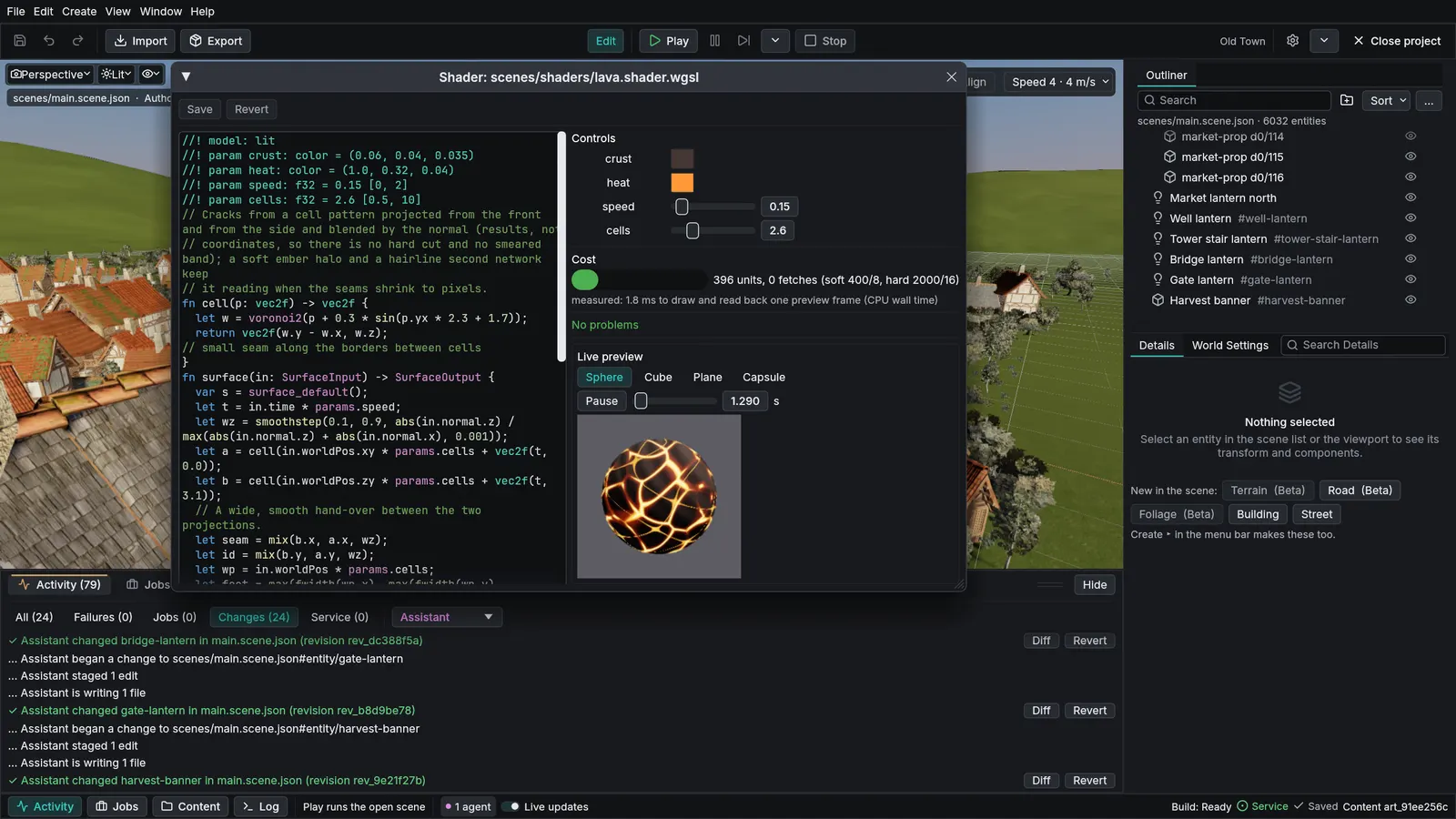
A shader code panel with colors, sliders generated from the code, error hints, a cost meter and a live preview. One shader file works in both the standard and high-definition renderers. Desktop exports prepare every shader while loading, so play does not stutter the first time an effect appears.
A good look by default
A scene that sets no exposure gets automatic exposure in the high-definition renderer, and both renderers share the same default tone curve, so a first scene looks right in either.
Packages
RenderingStableShipped
- Standard renderer
- Physically based materials
- Cached sun and light shadows
- Multisampling and bloom
Lighting and global illuminationBetaShipped
- Solstice real-time bounce and reflections
- Physical sky, clouds and exposure
- A good look by default
- Hardware ray-traced shadows and reflections (on at High and Ultra with ray-query hardware)
Virtualized geometry and far fieldBetaShipped
- Facet: detail without triangle budgets
- Baked far-field proxies
Coming in this area
- NowSharper terrain and distant forests. More terrain detail, better distant forests, and the standard and high-definition renderers looking alike.
- NextLocal exposure. Bright skies and dark interiors both readable in the same view.
- NextVolumetric light and better skin. Light shafts through fog and haze, scenes with many lights, and better translucency and skin.
- LaterHair and fur. Individual hair strands and fur.